
Podcast Production Company Vs In-House Team: Which Is Better For Your Branded Podcast?

You want to start a branded podcast. Smart move.
But now you're staring at two options: build an in-house team or hire a production company. And honestly? Most founders pick based on ego, not strategy.
Listen... this decision isn't about saving a few bucks or keeping creative control. It's about whether your podcast will actually build trust, authority, and demand, or just collect digital dust while your team drowns in WAV files and Adobe Audition tutorials.
Let's run both options through what I call the ruthless filter: Does this approach help you build a media asset that compounds, or does it just create more busy work?

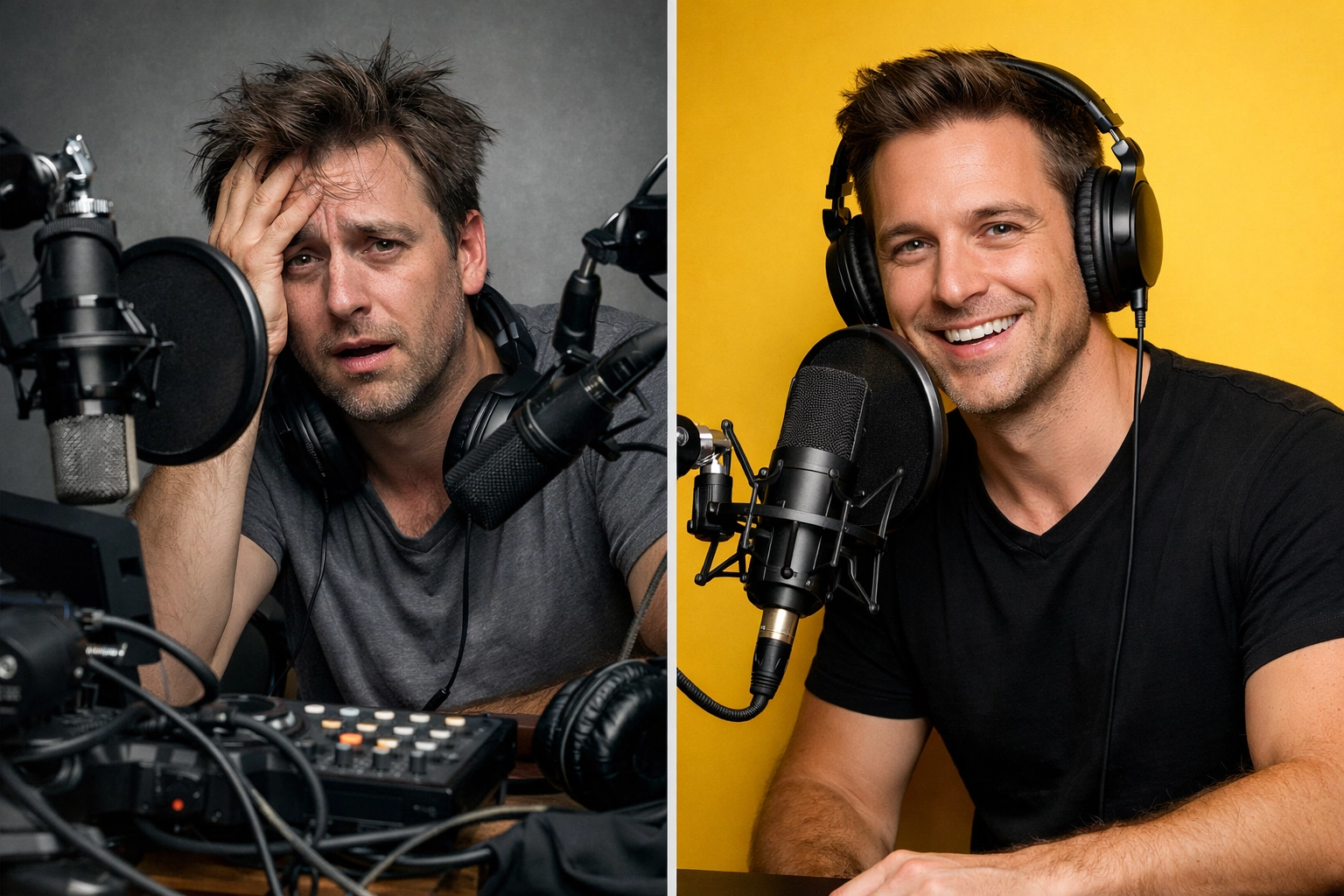
The White-Knuckle In-House Approach
Here's what doing it in-house really looks like.
Your marketing manager, who's already juggling three campaigns, a rebrand, and your quarterly board deck, now gets to add "podcast producer" to their LinkedIn headline. Cool.
They're Googling microphone comparisons at 11 PM. They're watching YouTube tutorials on noise gates and compression. They're scheduling recording sessions between investor calls. They're learning that exporting audio at the wrong sample rate means re-recording an entire interview.
And editing? That 45-minute conversation with your dream client? That's becoming a 6-hour editing marathon. Every "um," every phone notification, every time someone's kid walked in, it all has to get fixed.
The math is brutal.
One episode per week means your team is spending 10 hours (or more) on production alone. Not strategy. Not guest outreach. Not repurposing content. Just the technical grunt work of making audio not sound like garbage.
Right? Wrong.
That's best case scenario. Reality is messier. Episodes get delayed because Sarah's sick. Quality varies wildly because Josh edited this one and he's still figuring out EQ. Your distribution is manual. Your analytics are... well, you're just checking Apple Podcast downloads and calling it data.
Here's the thing nobody tells you: scaling an in-house podcast doesn't scale linearly, it scales exponentially.
Want to go from one episode to two per week? You're not doubling workload. You're tripling it. Because all the overhead, the setup, the quality control, the workflow coordination, compounds with volume.
And the absolute worst part? Your team is learning on your brand. Every amateur mistake, every audio artifact, every awkward edit, that's all public. Forever.
The Production Company Alternative (AKA The "Let Someone Else Be The Sound Engineer" Move)
Now let's talk about the other path.
You hire a production company like Speke. Here's what actually happens:
You show up. You record. You leave.
That's it.
No tech troubleshooting. No midnight editing sessions. No wondering if your audio sounds "professional enough." Your job is to be the expert, the authority, the face of the show. Someone else handles the 47 other things that make a podcast not suck.
The real advantage isn't just time, it's focus.
When you're not white-knuckling through Premiere Pro tutorials, you can actually think about strategy. Who should be on your show? What narratives are you building? How does this episode ladder up to your business goals? What's the throughline that makes someone binge three episodes and then book a call?
Boom. That's the stuff that actually moves the needle.
A good production partner brings:
Professional recording equipment that doesn't sound like you're in a tin can
Editing expertise that makes your guests sound smarter (and you sound sharper)
Consistent quality across every single episode, no variance, no amateur hour
Advanced analytics that go beyond vanity downloads
Distribution to every platform without you lifting a finger
The ability to scale without burning out your team
Listen... busy experts shouldn't be their own sound engineers. You wouldn't ask your CTO to also be the office janitor. Same principle applies here.

The Ruthless Filter: Does It Build Trust, Authority, and Demand?
Here's the framework that cuts through all the noise.
Every decision about your podcast should pass this test: Does it build trust, authority, and demand?
Not "Does it save money?" Not "Does it keep everything in-house?" Those are the wrong questions.
Trust means your show sounds professional. Zero audio glitches. Consistent quality. Guests feel respected. Listeners never wonder if you're legit.
Authority means you're positioned as the expert, not the amateur fumbling with tech. Your energy goes into insights, not troubleshooting. You're the voice of wisdom, not the frazzled producer praying the recording didn't corrupt.
Demand means your podcast actually generates outcomes. Outcomes happen when your show is tight, consistent, and strategically positioned: not when it's a side project drowning in logistics.
Let's be brutally honest: most in-house podcasts fail the ruthless filter.
They sound in-house. They feel like vanity projects. They get inconsistent. Episodes get skipped. Quality dips when the intern quits. And six months in, the whole thing quietly dies because "nobody had time."
A production company passes the filter if: and this is key: they actually understand strategy. Not just audio engineering. Not just editing. But the business objectives behind your show.
So Which One Is Right for You?
Real talk: it depends on your priorities.
Go in-house if:
You have genuine bandwidth (not fake "we'll find time" bandwidth)
Someone on your team actually wants to learn production and has the skills
You're doing a limited run: like 6 episodes, not 52
Maximum creative control matters more than speed or scalability
You want to test the format before committing budget
Hire a production company if:
Your time is worth more than the cost of the service (do the math: seriously)
You want professional quality from episode one, not episode fifteen
You're building a long-term media asset, not a one-off experiment
Your team is already maxed out and you're not interested in adding "podcast producer" to someone's job description
You want to scale without destroying your team's sanity
Here's my take: if your podcast is strategic: if it's part of your authority-building, demand-generation playbook: then treating it like a professional media property matters. And that usually means bringing in people who do this for a living.
You wouldn't DIY your website, your brand video, or your product demo. Why white-knuckle your podcast?
The Real Cost Isn't Money: It's Opportunity
The trap most founders fall into is focusing on hard costs while ignoring opportunity cost.
Sure, paying a production company costs more upfront than doing it in-house. But what's the cost of:
Your marketing director spending 10 hours a week on audio production instead of strategy?
Launching with mediocre quality and training your audience to expect amateur-hour content?
Inconsistent publishing that kills momentum and listener trust?
Delayed episodes because your team is underwater?
Those costs are real. They just don't show up on a P&L.
Listen...podcasts fail not because of bad content, but because of bad execution. The idea is solid. The host is smart. But the logistics crush them. The technical overhead becomes a tax they can't afford to pay.
That's the white-knuckle approach in action. And it's a damn shame.
What's Your Next Move?
If you're serious about launching a branded podcast that actually builds authority and generates demand: not just another content experiment that dies in six months: you need a plan.
We built PodQuest specifically for founders and executives who want to cut through the noise and figure out the smart play. It's our roadmap for building a podcast that works for your business, not against it.
No fluff. No vanity metrics. Just the strategic framework for making your show a real media asset.
Whether you go in-house, hire us, or hire someone else: just make sure you're passing the ruthless filter. Trust, authority, demand. Everything else is noise.
Freddy with a Y
Comments